
We Buy Gold
Less a slogan than a subculture — and it isn’t always pretty

Welcome to Through a Lens Darkly, my weekly notes on pictures, perception and life as a documentary photographer. New essays are free for one week before moving behind the paywall.
Subscribe to unlock the full archive →
You can also follow my work on Instagram and YouTube.
Jeremiah Moss poignantly wrote, “The developers circle like vultures, hungry to turn this untamed block into another sanitized American mall. But for now, it remains an oasis, a place that still hums with the unruly soul of the city.”
On 47th Street, between Fifth and Sixth Avenues, the Diamond District compresses global wealth into a single, city block.
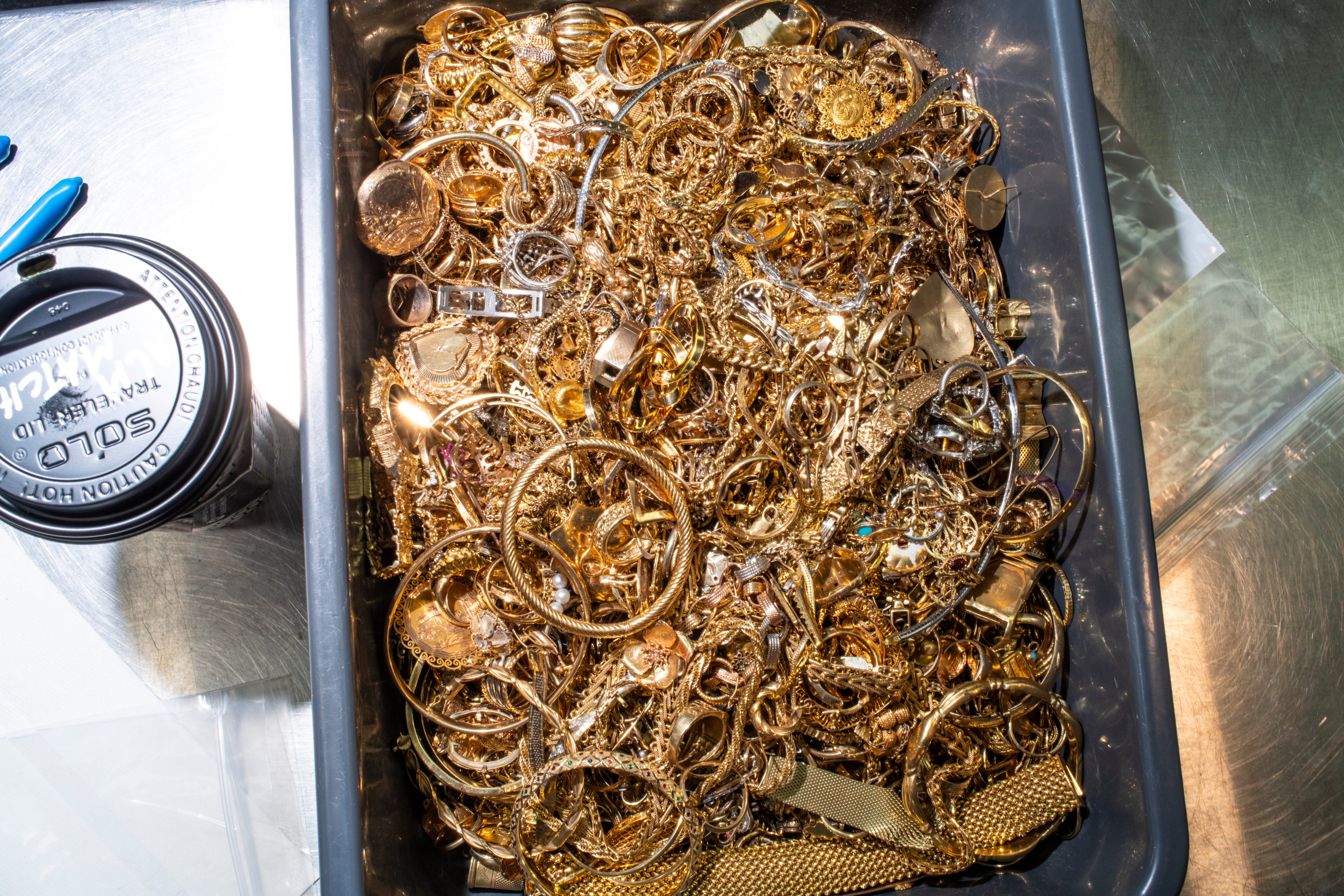
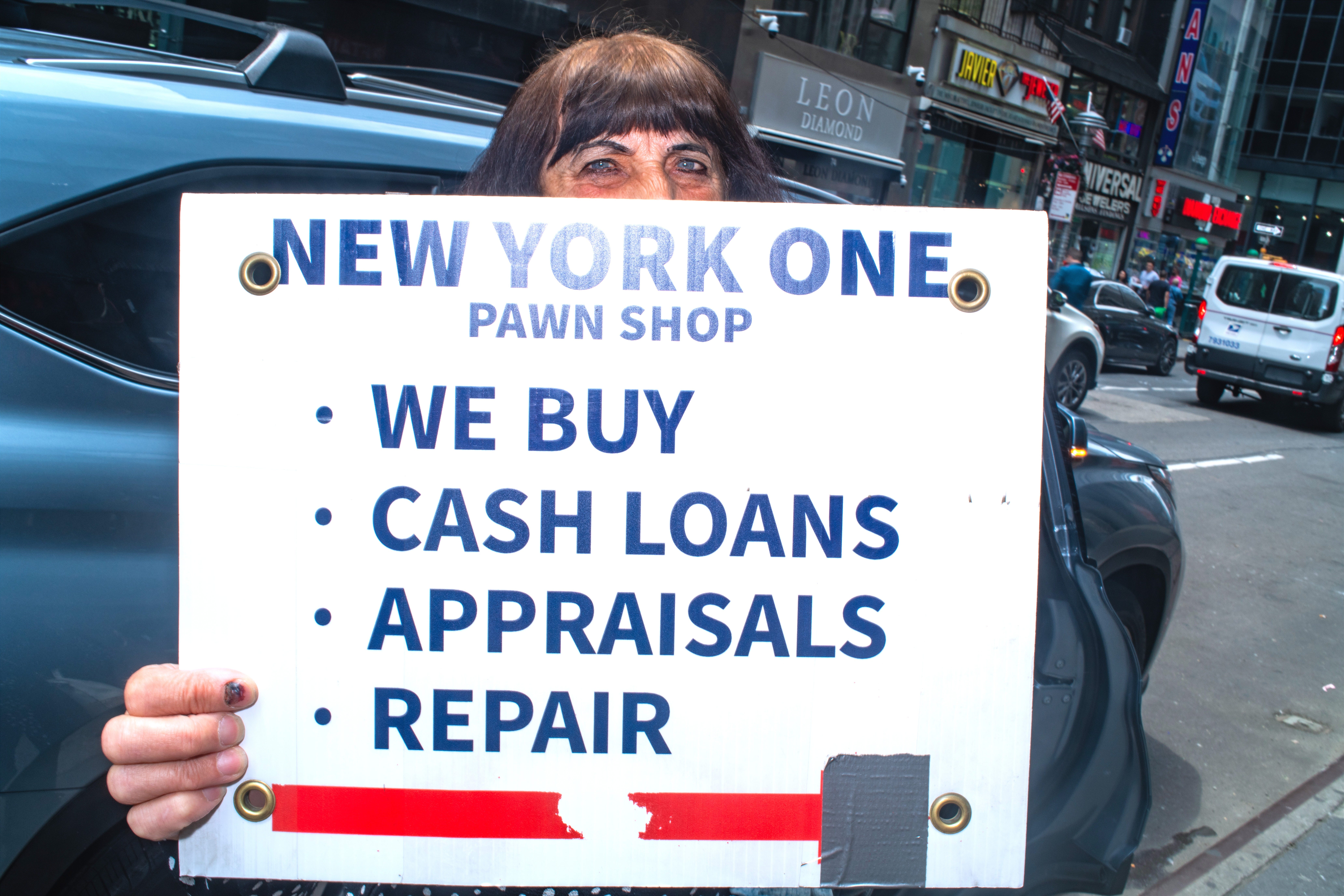
It is a place of shops and booths, fluorescent lighting, and constant negotiation. It is where gems and metals are weighed, tested, argued over. Quietly (or not so quietly), they are transformed from inventory into livelihood. But for every tray of stones under a loupe, I’ve noticed there is another economy moving in parallel: the men (and 1 woman) with “We Buy Gold” signs on the sidewalks outside.
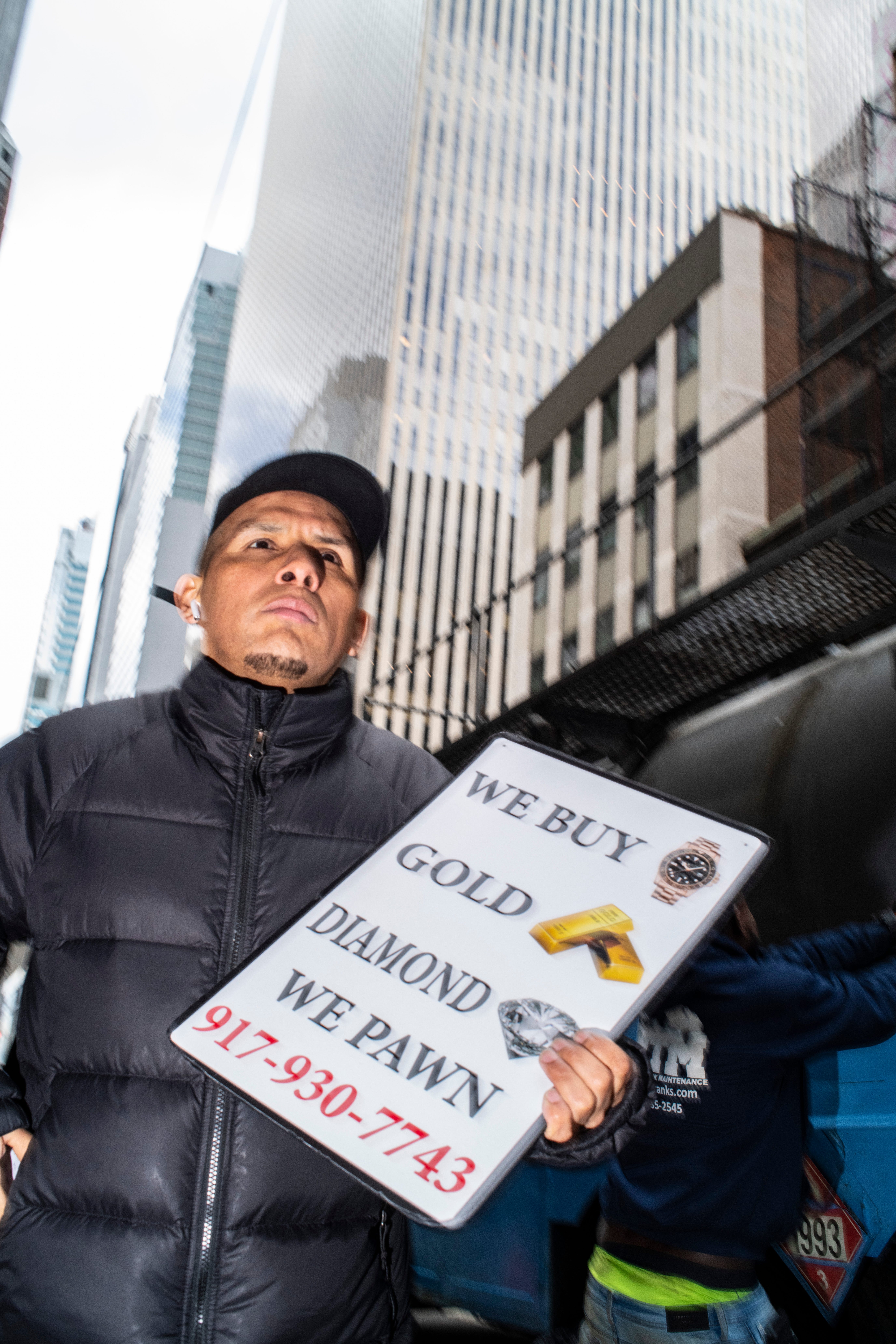
The sign-people are both invisible and hard to miss. They pace the same few meters of sidewalk just beyond thresholds of the pawn shops and gold scrappers who employ them. They occupy the liminal space between retail and street cultures. The signs are graphic, repetitive, nearly interchangeable. Broken chains, gold rings, old watches — everything is welcomed and everything is valued for the melt price. All of it is scrapped in the end. The very phrase “We Buy Gold” itself has become ambient noise in New York. But on 47th Street it carries a sharp edge.
It is less branding and more shorthand for survival.
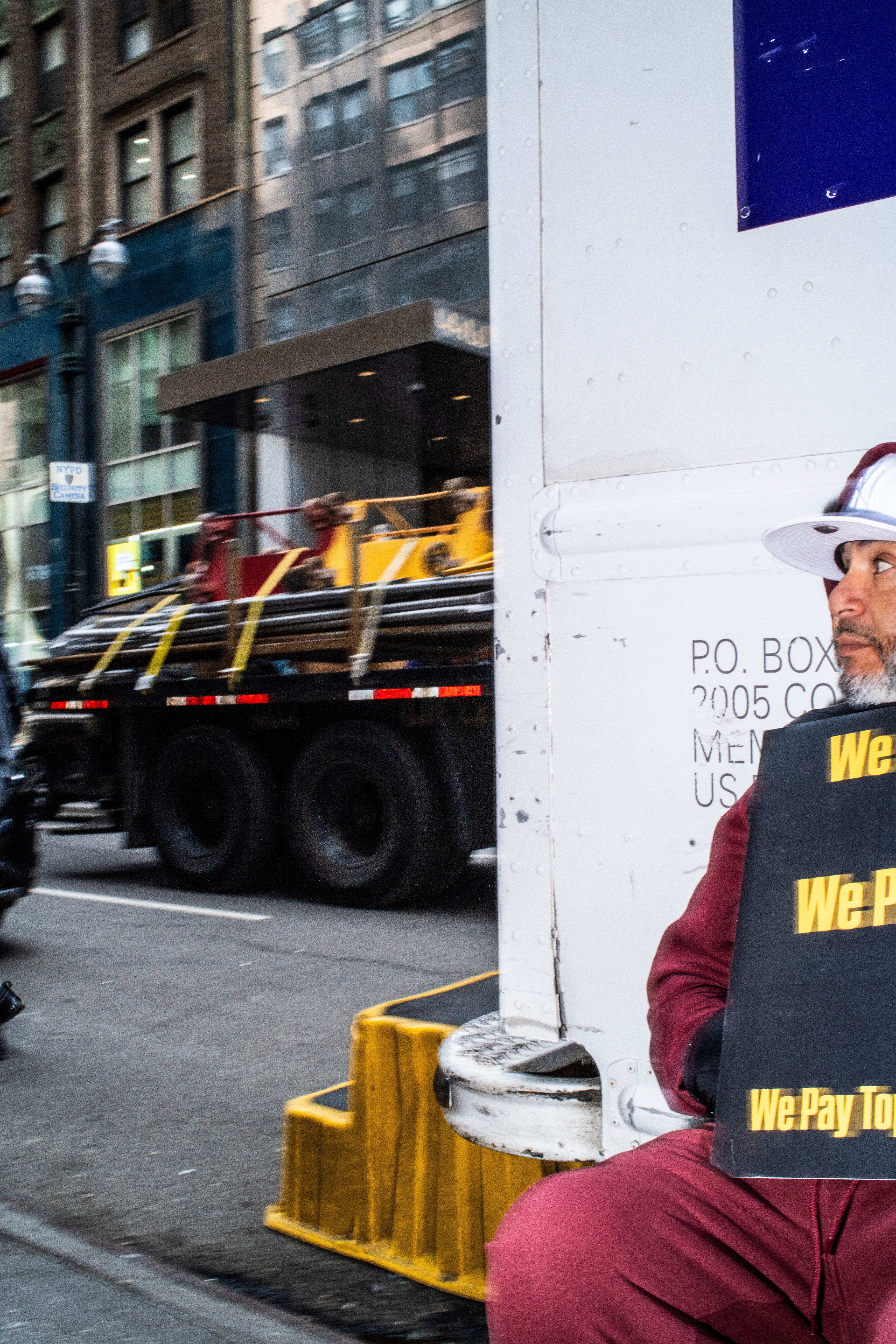
Woven into my dissertation on 47th Street culture are pictures of these sign-holders.
Although the entire project was recently shortlisted for the Belfast Photo Festival 2026 and reviewed by Dr. Lisa Sutcliffe of the Metropolitan Museum of Art and Dr. Roxanna Marcoci of the Museum of Modern Art’s Photography Department, for the purposes of this article, I am focusing on a single element of the work; the seemingly transient yet all-too-permanent sign-holders.
I built these pictures around that edge.
To my eye, the Diamond District is not an enclave of luxury, but a working-class neighborhood under pressure to out-perform itself. This is a place where generational businesses are squeezed by the economy, redevelopment and human cost.
Jeremiah Moss poignantly wrote, “The developers circle like vultures, hungry to turn this untamed block into another sanitized American mall. But for now, it remains an oasis, a place that still hums with the unruly soul of the city.”
That “unruly soul” is not democratically distributed - it flickers among those who, over decades, have inherited jewelry businesses from fathers and uncles, from those escaping war and from those who had to learn a new trade to survive. From family love and trust, generational connection and plain old neighborhood grit.
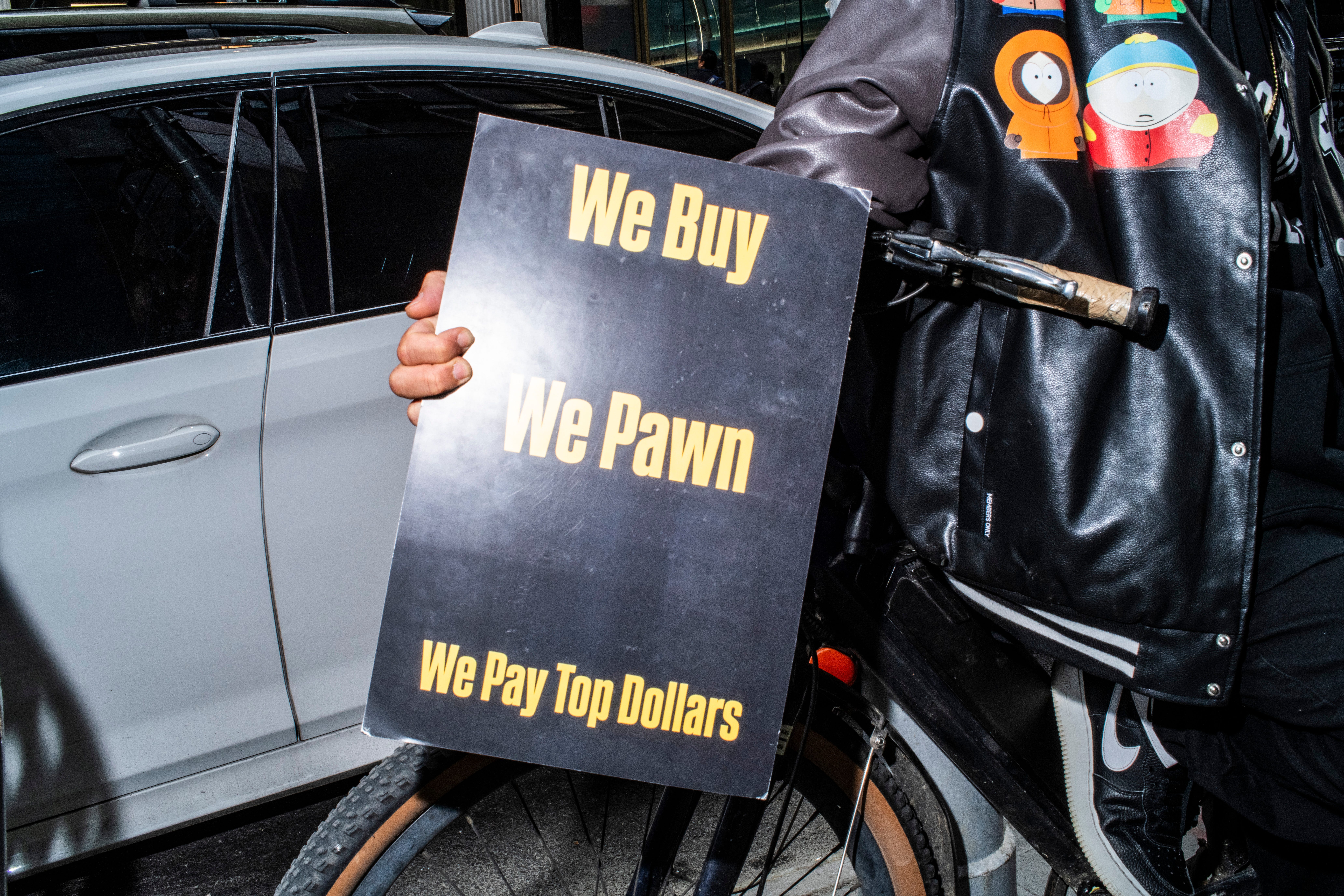
Outside, though, the jobs different.
They are higher risk because the people holding the signs are themselves exposed. There is no locked door, no armed guard to protect them. Just the social code of the block, and a foam-board missive promising fast cash and no chit-chat.
The sign holders are part of a writ large shadow infrastructure to which we have all become inured. They keep the street active, positioned on the edge of formal economy while remaining outside of it. Without them, though, the district’s movement would be decidedly slower. And with them, the block appears more frictionless; their steady appearance engenders an odd type of trust. I’ll admit to a familiar form of self-preservation in deliberately avoiding eye contact, as women have oft learned to do. Nothing new to see here.
Still, there is something dissonant about their presence. 47th Street is associated with permanence and luxury. With watches and pendants. But a glance at the sidewalk evokes a far different feeling.
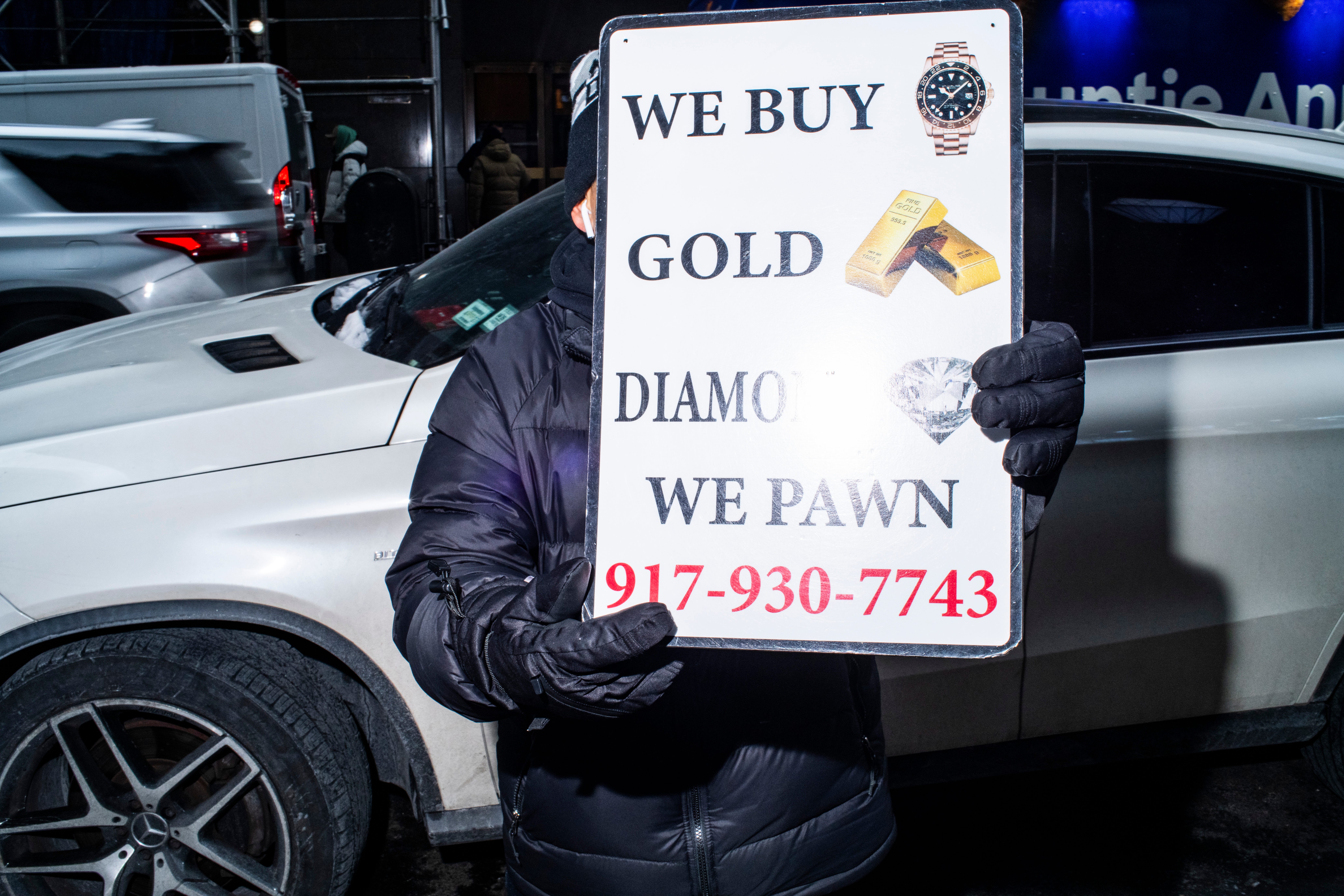
I think we can all agree that these are not positions of arrival.
These are positions of exposure: to weather, foot traffic and unpredictable rhythms. A slow hour is not downtime; it is a reminder of how thin the line is between being visible and being overlooked.
It would be too simple, and too careless, to frame this as decline or failure. Many of these men—and I’ve counted one (1) woman—have done this work for the entire three years I’ve been shooting on the block. There is still a gravity to their posture, though: standing for hours holding a sign that reduces a complex set of skills and risks into three blunt words, “We Buy Gold”, on signs that are commonly misspelled. There is something almost epitaphic in it, stripped down - unadorned.
Family run gem dealers pass down not just inventory but reputation; relationships with suppliers in Antwerp, Tel Aviv, Mumbai. Some booths have remained in families for over half a century. Others have been bought, sold, or absorbed by associates with no visible lineage.
In that context, these sidewalk workers are not an anomaly so much as an extension of the same system: a layer of labor that absorbs uncertainty.
But their emotional register is hard to ignore. There is a particular kind of waiting that defines the job. For many passersby, especially women moving alone through the block, the approach can feel intrusive - an unavoidable friction in the sidewalk economy.
For those holding the signs, the day is built from repetitions like this: conversations that rarely resolve into transactions, attention that rarely converts into sale.
And yet, their work continues.
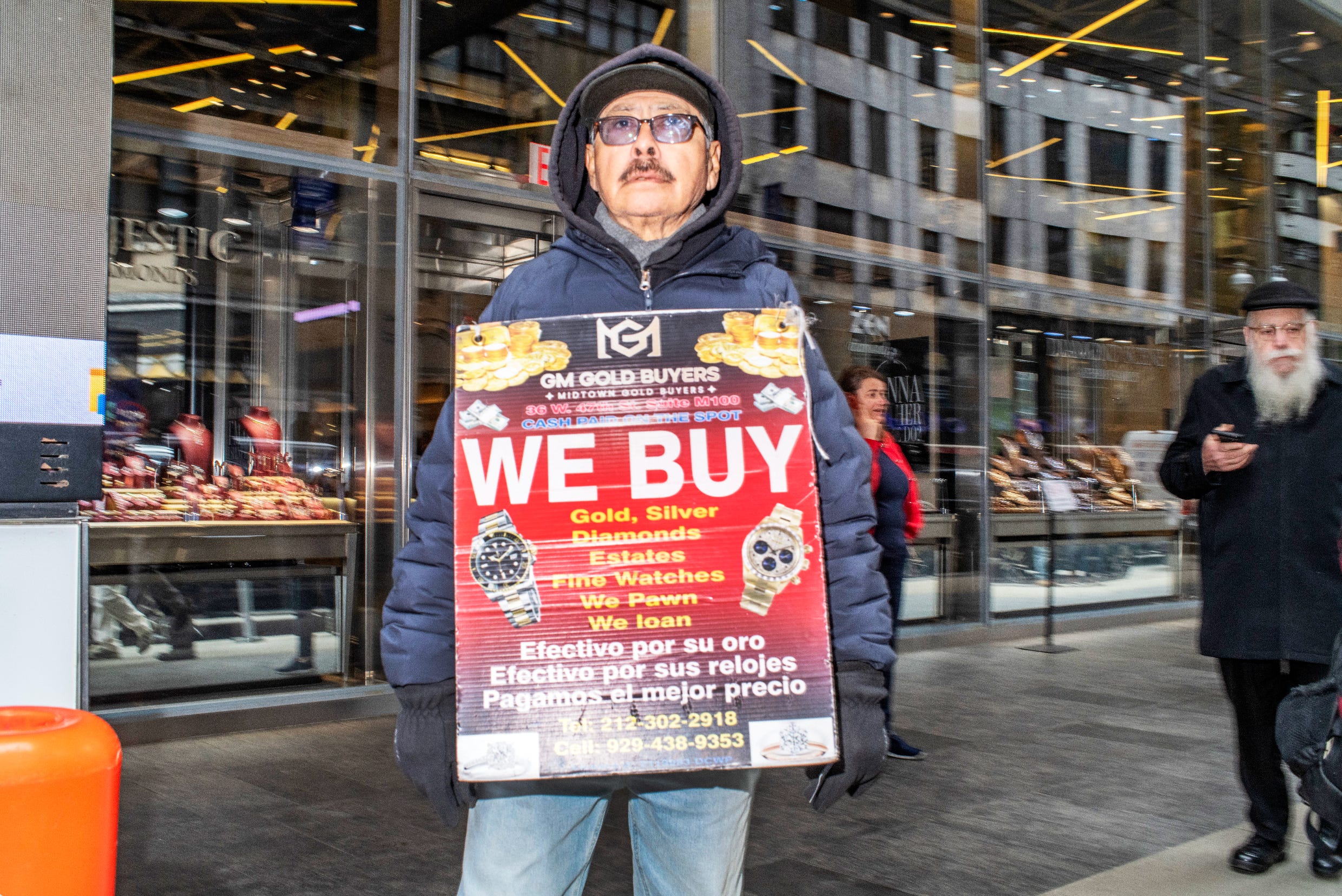
Redevelopment pressures are not abstract here; a flagship big-box store has just just broken ground at the end of the block.
It is rumored to be an IKEA. This idea of transformation, of a “sanitized American mall,” as Moss puts it, hovers as both threat and inevitability, depending on whom you ask.
In that context, the sign holders become indicators of how value is redistributed in real time. They stand at the point where private accumulation meets public visibility.
There is a tendency, when making work like this, to search for narrative resolution. There is a want to either uplift or decline. But the Diamond District resists that. It is neither disappearing nor fully intact. It is a working contradiction: a place where generational stability coexists with precariousness, where wealth is both inherited and recruited from the sidewalk.
The people holding “We Buy Gold” signs sit on the thread between these two disparate conditions. They are not outside the system; they are part of its circulation.
Still, their presence raises an uncomfortable question: what kinds of labor remain visible in cities like New York, and which jobs and which people are designed to be overlooked?
It is not a clean story. It is continuity under pressure. On 47th Street, continuity often takes the form of someone bedraggled in a sandwich board.

Buy a zine here.
Grab my book here.
Or buy a girl an espresso shot here ☕️.
Thanks for reading! Your curiosity keeps this work alive.
Subscribe to unlock all essays →
You can also follow my work on Instagram and YouTube.
Join other readers supporting this work and gain full access.